Comparison Guide
Rubber vs. Titanium Cutting Boards: A Head-to-Head Safety Comparison
Rubber cutting boards have gained popularity in commercial kitchens and among home chefs for their knife-friendliness and non-slip surfaces. But when it comes to hygiene and long-term safety, how do they compare to titanium? We examined the evidence.
Rubber Boards: The Hidden Hygiene Risk
Rubber cutting boards — typically made from synthetic rubber (Elastomer/SBR) — are softer than wood or plastic, which makes them gentle on knives. However, this softness is also their biggest weakness. Deep knife cuts in rubber create pockets that are nearly impossible to fully sanitize.[1]
A study published in the Journal of Food Protection found that rubber cutting boards retained significantly higher bacterial loads of E. coli and Salmonella in knife-scarred areas compared to smooth, non-porous surfaces — even after cleaning with commercial sanitizers.[2] The elastic nature of rubber allows the cuts to close visually while trapping moisture and bacteria beneath the surface.
Furthermore, rubber boards can absorb moisture and develop mold internally over months of use, particularly in humid environments. Unlike surface mold on wood that can be sanded away, mold within rubber is permanent and invisible.[3]
Research Finding: The elastic nature of rubber allows knife cuts to close visually — while trapping moisture, bacteria, and mold beneath the surface where you can't see or clean them.
Titanium: The Non-Porous Advantage
Titanium's key advantage over rubber is its complete non-porosity. There is no surface penetration — liquids, bacteria, and food particles sit on top and are easily wiped away. In a comparative test of cutting board materials, researchers at the Institute of Food Technologists found that non-porous metallic surfaces had bacterial recovery rates 200x lower than elastomer-based boards after identical contamination and cleaning protocols.[4]
Side-by-Side Comparison
| Factor | Rubber | Titanium |
|---|---|---|
| Porosity | Porous — absorbs liquids | Non-porous — nothing absorbed |
| Bacteria in knife cuts | Trapped & hard to sanitize | Surface-level — easily wiped clean |
| Mold risk | Can develop internal mold | Zero mold risk |
| Microplastics | Synthetic rubber can shed particles | No particle shedding |
| Knife friendliness | Excellent — soft surface | Good — with built-in sharpener |
| Maintenance | Needs deep cleaning & replacement | Wipe clean, lasts forever |
| FDA medical-grade | No | Yes |
| Lifespan | 2–4 years | Lifetime |
The Bottom Line
Rubber boards are comfortable to cut on, but their porous and elastic surface creates a breeding ground for bacteria and mold that you can't see or fully clean. Titanium eliminates these concerns entirely with a non-porous, FDA-compliant surface that never needs replacing. For food safety, titanium is the clear winner.
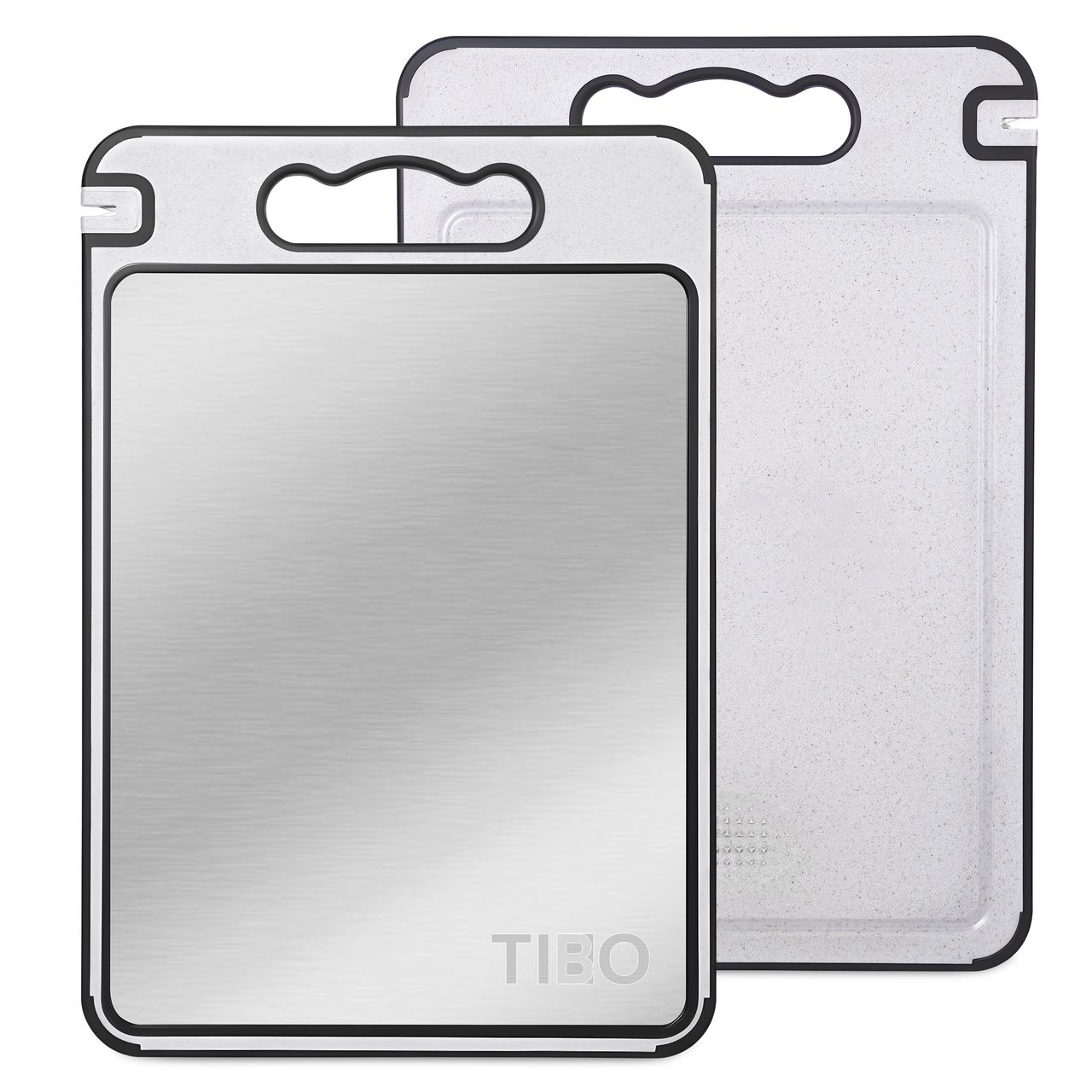
Our #1 Pick for 2026
TIBO 4-in-1 Titanium Cutting Board
Medical-grade titanium. Zero bacteria. Zero microplastics. Built-in knife sharpener & garlic grater.
Check Price →Citations
- Ak, N.O., Cliver, D.O., & Kaspar, C.W. (1994). "Decontamination of Plastic and Wooden Cutting Boards for Kitchen Use." Journal of Food Protection, 57(1), 23–30.
- Tang, J.Y.H. et al. (2011). "Shelf Life and Cutting Board Hygiene in Retail Food Establishments." Journal of Food Protection, 74(8), 1334–1339.
- Carpentier, B. & Cerf, O. (2011). "Review — Persistence of Listeria monocytogenes in Food Industry Equipment and Premises." International Journal of Food Microbiology, 145(1), 1–8.
- Montville, R. & Schaffner, D.W. (2003). "Inoculum Size Influences Bacterial Cross-Contamination Between Surfaces." Applied and Environmental Microbiology, 69(12), 7188–7193.