Health & Safety
The Hidden Danger: How Your Plastic Cutting Board Contaminates Your Food
Plastic cutting boards are the most common type found in American kitchens — affordable, lightweight, and dishwasher safe. But a wave of new research suggests that every time you drag a knife across a plastic board, you may be feeding your family invisible plastic particles. Here's what the science says.
The Microplastic Problem
A groundbreaking 2023 study by researchers at North Dakota State University and published in Environmental Science & Technology found that a single plastic cutting board can generate between 14.5 million and 71.7 million microplastic particles per year depending on usage frequency and cutting intensity.[1] These particles — invisible to the naked eye — mix directly into the food being prepared and are consumed unknowingly.
The study tested both polyethylene (PE) and polypropylene (PP) boards, the two most common materials used in consumer cutting boards. Both released significant quantities of microparticles, with heavily scarred boards releasing up to 1,114 microplastic particles per square centimeter of knife-damaged surface.[1]
Alarming Statistic: A single plastic cutting board can release between 14.5 million and 71.7 million microplastic particles per year — all of which are ingested in your food.
What Happens When You Ingest Microplastics?
Research is increasingly linking microplastic ingestion to serious health concerns:
- Bloodstream contamination: A 2022 study in Environment International detected microplastic particles in 80% of human blood samples tested, with PET and polystyrene being the most common types found.[2]
- Endocrine disruption: Microplastics can carry chemical additives like BPA and phthalates, which are known endocrine disruptors linked to hormonal imbalances, reproductive issues, and developmental problems.[3]
- Inflammation & cellular damage: Laboratory studies have shown that microplastic particles can trigger inflammatory responses and oxidative stress in human cells, particularly in the gastrointestinal tract.[4]
- Accumulation in organs: A 2024 study published in the New England Journal of Medicine found microplastic deposits in arterial plaque, associating their presence with a 4.5x higher risk of cardiovascular events.[5]
Why Titanium Eliminates This Risk Entirely
Unlike plastic, titanium is an elemental metal — it does not shed particles, degrade, or break down during use. Its non-porous, solid surface means zero microplastic contamination, zero bacterial absorption, and zero chemical leaching. It is the only cutting board material that carries FDA compliance for direct contact with human tissue, the same certification required for surgical implants placed inside the human body.[6]
While titanium boards carry a higher upfront cost, the health implications of continued plastic cutting board use — combined with the need to replace plastic boards every 1–2 years — make titanium the safer and more economical choice over time.
What You Can Do Today
If you're still using a plastic cutting board, especially one with visible knife marks, consider replacing it immediately. The more scratched the surface, the more microplastics are released with every cut. Switching to a non-porous material like titanium is the most effective way to eliminate this exposure for you and your family.
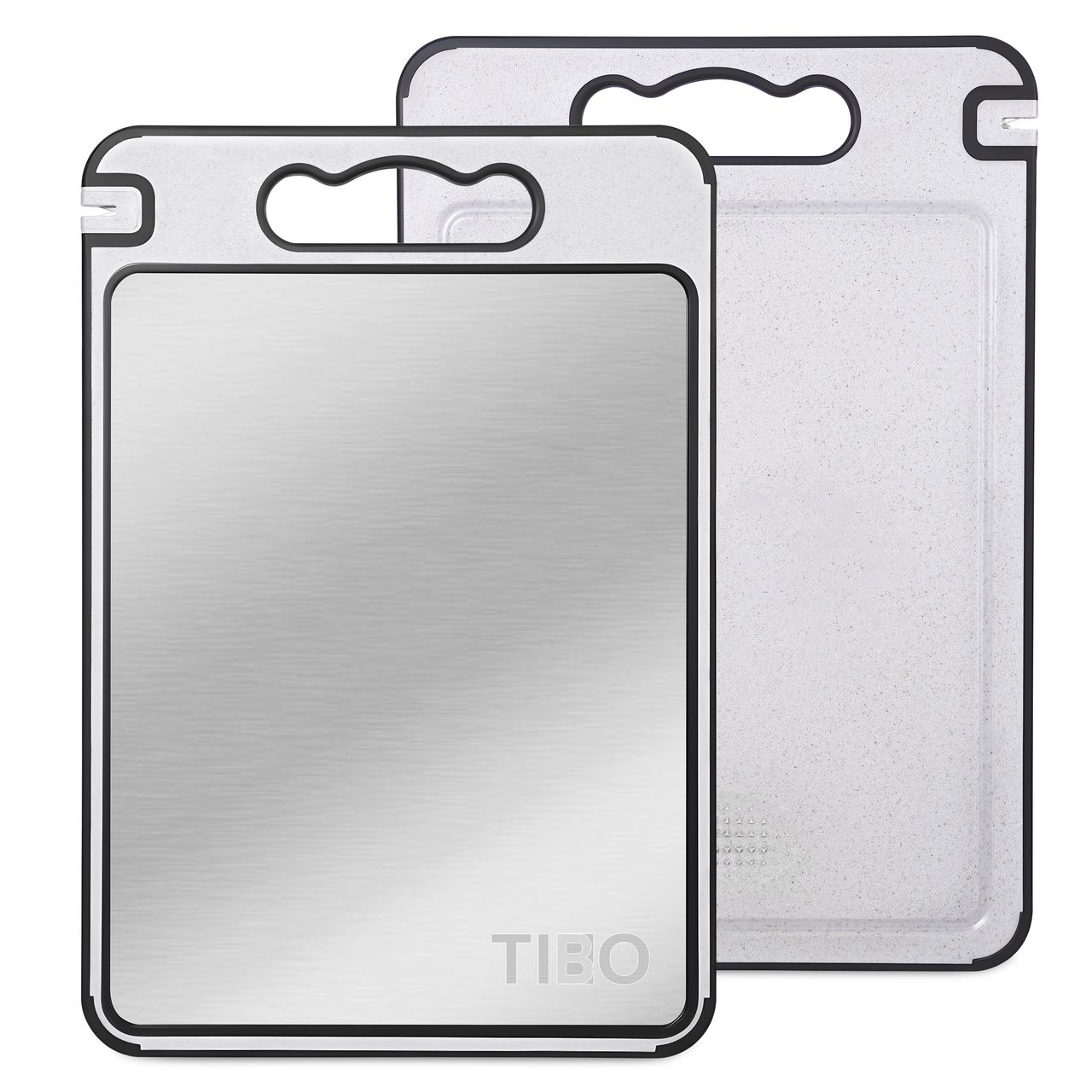
Our #1 Pick for 2026
TIBO 4-in-1 Titanium Cutting Board
Medical-grade titanium. Zero bacteria. Zero microplastics. Built-in knife sharpener & garlic grater.
Check Price →Citations
- Hernandez, L.M. et al. (2023). "Microplastics Generated from Cutting Food on Plastic Cutting Boards." Environmental Science & Technology, 57(22), 8264–8272.
- Leslie, H.A. et al. (2022). "Discovery and Quantification of Plastic Particle Pollution in Human Blood." Environment International, 163, 107199.
- Rochester, J.R. (2013). "Bisphenol A and Human Health: A Review of the Literature." Reproductive Toxicology, 42, 132–155.
- Deng, Y. et al. (2017). "Tissue Accumulation of Microplastics in Mice and Biomarker Responses Suggest Widespread Health Risks of Exposure." Scientific Reports, 7, 46687.
- Marfella, R. et al. (2024). "Microplastics and Nanoplastics in Atheromas and Cardiovascular Events." New England Journal of Medicine, 390, 900–910.
- ASTM F67-13. "Standard Specification for Unalloyed Titanium for Surgical Implant Applications." ASTM International, West Conshohocken, PA.